
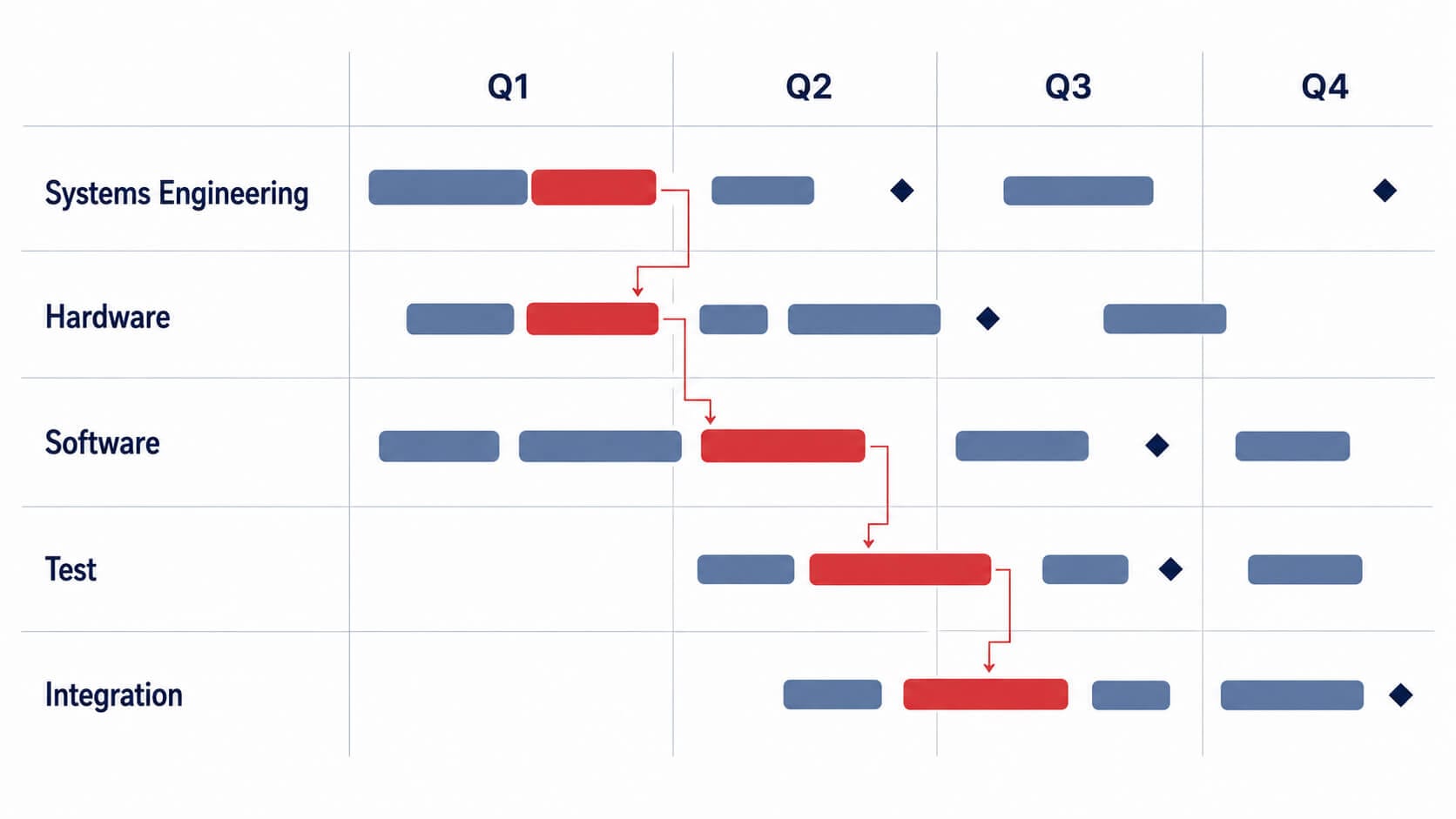

Slip a task by ten days. If nothing downstream moves, you do not have an IMS. You have a Gantt chart wearing an IMS label. An integrated master schedule is one networked schedule holding every task on a program, logically linked so a critical path can be calculated end to end. On DoD work it becomes a contract deliverable when the contract or CDRL requires it. Without that requirement the same network discipline still pays for itself internally. The IMP sets the gates. The IMS schedules the work required to get through them.
IMS and IMP Are Not the Same Document
People use the two terms interchangeably and then wonder why their schedule review goes badly.
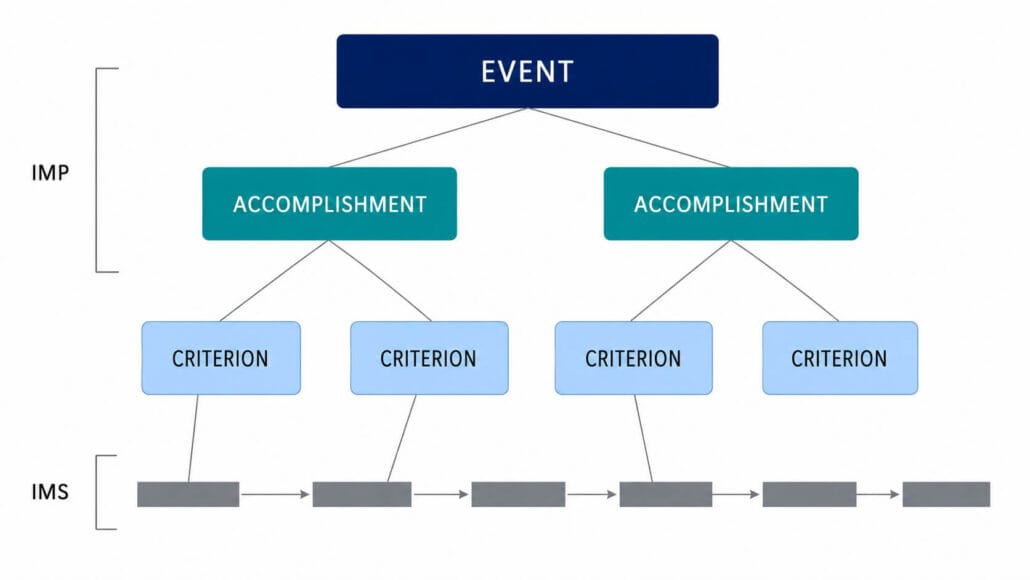
The IMP has no calendar in it. It works downward from an event to the accomplishments required for that event, then to the criteria that prove each accomplishment is done. DoD’s own definitions put it in exactly that order. Preliminary Design Review is an event. “Design meets weight allocation” is an accomplishment. The specific analysis that demonstrates it is a criterion.
The IMS is the calendar version of that hierarchy. Take a criterion and follow it into the schedule. You should land on real work with a duration and logic tying it into the rest of the network. The IMP says what has to be true. The IMS says when, and what has to happen first.
You do not need a formal IMP to build an IMS. But you do need a hierarchy above the task list: contract milestones, a WBS, or another framework that tells every task what it is supporting. Starting from a flat task list and hoping structure emerges produces a large Gantt chart, not an integrated master schedule.
Build It Down From the Events, Not Up From the Tasks
Start with the program events in the order the contract requires them. Decompose each into accomplishments, then criteria, then the tasks that satisfy each criterion. Align the whole thing to the work breakdown structure so that cost and schedule report against the same elements.
Then link it. Every task except the first gets a predecessor. Every task except the last gets a successor. This sounds obvious and it is the single most commonly violated rule in real schedules.
Resource-load it if the contract requires it, and expect that to change your durations. Do not call an activity two weeks long because that was the estimate with a full team. If the plan now gives it one engineer, the duration needs another look.
Traceability Is What Makes It Integrated
Two kinds, and a schedule needs both.
Horizontal traceability means the logic links across the schedule reflect real handoffs. If the test team cannot start until the hardware arrives, that link exists in the file. Drag the hardware task right by three weeks and the test task should move with it. If it does not budge, the link was never there.
Vertical traceability is that same discipline running up and down. Open the executive milestone, then drill into the detail behind it. The dates and the scope have to reconcile. If the top-level view says PDR is June 12 and the supporting schedule says June 26, one of them is lying.
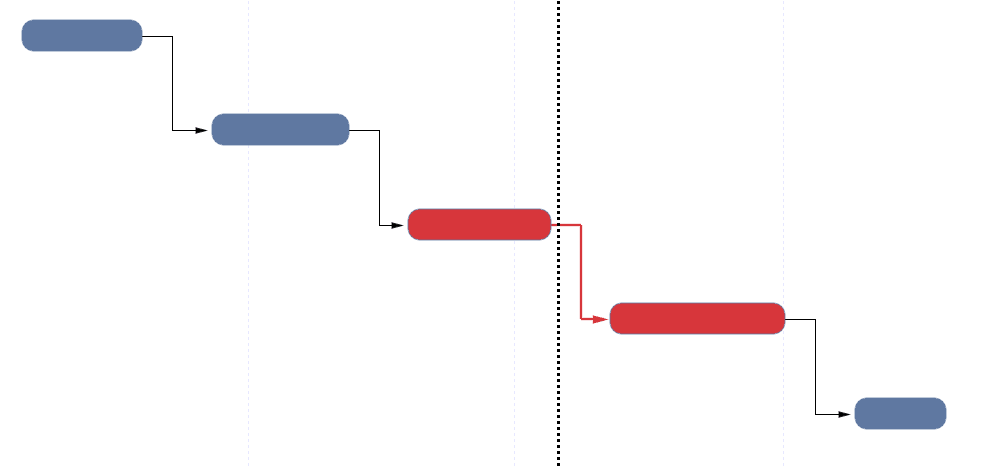
The test for both is whether logic runs continuously through to every controlling milestone, and there is rarely only one such path. Where a chain stops partway, something is missing logic or pinned by a constraint, and the float everywhere downstream of it is fiction.
Where These Schedules Break
Constraints used instead of logic. In Microsoft Project, a task pinned with Must Start On anchors to that date and by default overrides predecessor logic. It stops transmitting delay, which defeats the point of building a network. Constraints should be rare and every one should have a documented reason.
Lags covering for missing tasks. A 30-day lag usually means real work nobody wanted to schedule. Cure time and shipping are legitimate. “Waiting for approval” is a task with an owner.
Detail nobody maintains. A 12,000-line IMS updated monthly by one person is worse than a 3,000-line one updated weekly by the leads who own the work. Detail you cannot status honestly is a liability, because it looks authoritative while being stale.
Presenting the whole thing. Nobody reads a 12,000-line schedule in a program review. Build the executive view from the same schedule. Use consistent symbology so a milestone means the same thing on every page. Then deal with getting a readable export out of Microsoft Project without turning the review deck into six-point type.
Run the 14-Point Schedule Metrics before a reviewer does. Formerly the DCMA 14-point assessment, they flag exactly the failures above: missing logic, hard constraints, excessive lags, negative float, and a critical path that does not survive a deliberate delay. Every one of those is cheaper to explain inside your own team than across a government conference table.
When You Do Not Need One
Here is the unpopular part: most schedules called an IMS are not one, and plenty of projects carrying the label would be better off without the machinery.
The machinery earns its keep on work with real interfaces: one organization slips hardware and another organization’s test window moves with it. Add contractual milestones and outside scrutiny of the schedule, and the maintenance cost starts making sense. A commercial project with one team and a six-month horizon gets none of that value and pays the full cost.
If you cannot name who reads the critical path and what decision it changes, you want a well-built Gantt chart with real dependencies. That is not a lesser thing. It is the right tool.
Prove It by Breaking It
Before you call the schedule done, pick a driving activity and push it ten working days. Recalculate. Follow the damage to the delivery milestone. If the delay vanishes halfway through, fix the network before anyone trusts the date.
